Listening to the Heartbeat of Your Database: Understanding Change Data Capture (CDC)
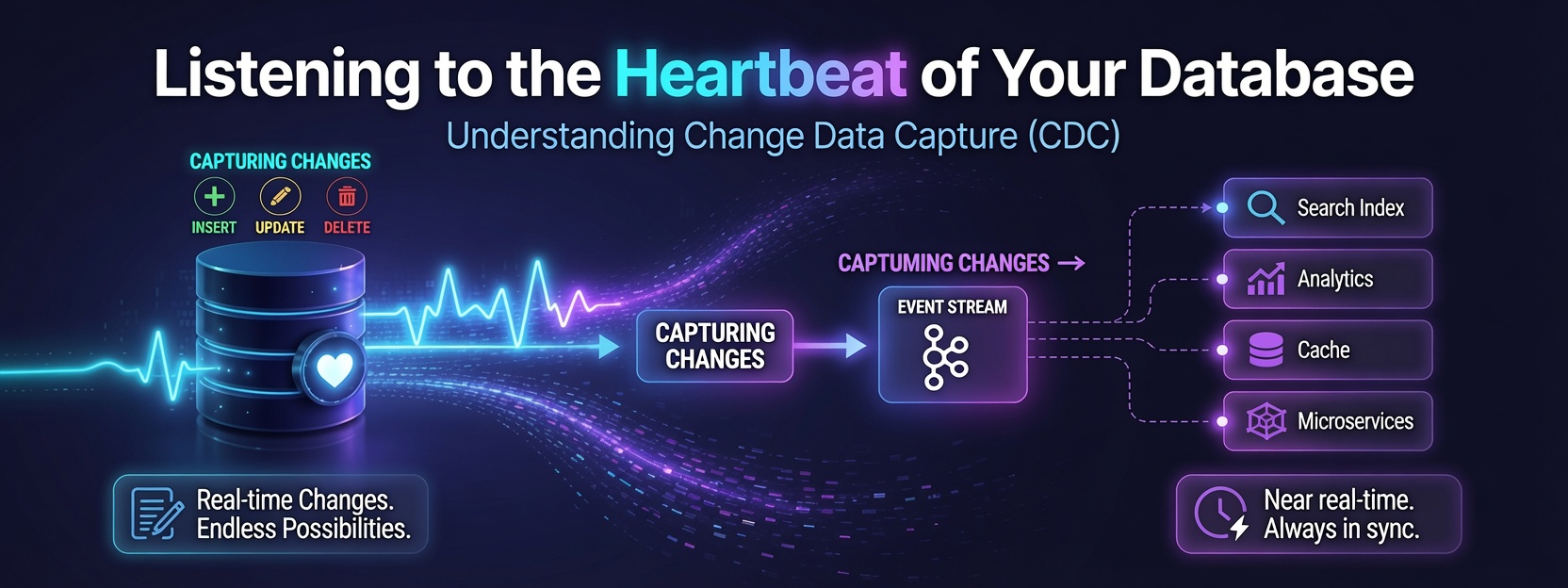
CDC stands for Change Data Capture.
What You Will Learn
- What CDC is
- The story behind it
- How it works internally
- Common use cases
- A simplified implementation example
What Is CDC?
Change Data Capture (CDC) is a technique for capturing changes made to data and exposing those changes to external systems.
Instead of repeatedly querying a database to check whether something has changed, CDC allows applications to consume a stream of inserts, updates, and deletes as they happen.
Think of CDC as a way to listen to the heartbeat of your database.
Every time data changes, the database records that change internally. CDC makes those changes available so that other systems can react to them in real time.
The Story Behind CDC
To understand CDC, it helps to understand how databases have worked for decades.
Whenever data changes, databases do not simply overwrite the old value and move on. They maintain an internal record of operations that have occurred.
These records are commonly stored in transaction logs.
Historically, every database implemented these logs differently, but the purpose was always the same:
- Record every change made to the database
- Recover from failures
- Replicate data to other nodes
- Maintain consistency
Every insert, update, and delete operation generates a log entry.
These entries are ordered and identified by a unique position or token.
The ordering is critical.
Imagine the following sequence:
- Create User
- Update User
- Delete User
If a replica applied these operations in a different order, it would end up with completely different data.
Because these logs are ordered, databases can reliably replay changes and reconstruct state over time.
This is how replication works in many database systems.
A replica typically starts with an initial snapshot and then continuously applies new changes by replaying the transaction log.
Where CDC Comes In
Originally, these logs were intended for the database itself.
CDC extends that idea by allowing external applications to consume those same changes.
Instead of only replicas reading database changes, your applications can read them too.
This means that whenever data changes, you can react immediately without constantly querying the database.
The underlying idea is simple:
Expose an ordered stream of database changes that external systems can consume reliably.
How CDC Works
Different databases implement CDC differently, but the concept remains the same.
MongoDB
MongoDB provides CDC through Change Streams.
Each event contains a resume token, which allows consumers to continue reading from the last processed change after a restart or failure.
MySQL
MySQL exposes changes through its Binary Log (Binlog).
CDC tools can read the binlog and transform database operations into events.
PostgreSQL
PostgreSQL provides CDC through Logical Decoding and Logical Replication.
These mechanisms allow applications to consume database changes in order.
Although the implementations differ, they all provide the same capability:
An ordered stream of database changes.
CDC Is Usually Pull-Based
One common misconception is that databases push changes directly to your application.
In reality, most CDC implementations are fundamentally pull-based.
The consumer requests the next available change from the database.
However, applications typically maintain a long-lived connection or cursor, making the experience feel very similar to receiving pushed events.
For example, MongoDB’s watch() API keeps a stream open and continuously delivers new events as they become available.
From the application’s perspective, it feels real-time.
A Simplified CDC Example
To understand the concept, imagine that every database change is converted into a standardized event.
function captureDataChange($operation, $table, $id, $before, $after)
{
    $cdcEvent = [
        "metadata" => [
            "operation" => $operation,
            "table" => $table,
            "id" => $id
        ],
        "before" => $before,
        "after" => $after
    ];

    echo "Streaming event: " . json_encode($cdcEvent) . PHP_EOL;
}

captureDataChange(
    "UPDATE",
    "users",
    42,
    ["name" => "Alice", "role" => "Developer"],
    ["name" => "Alice", "role" => "Architect"]
);
Output:
{
  "metadata": {
    "operation": "UPDATE",
    "table": "users",
    "id": 42
  },
  "before": {
    "name": "Alice",
    "role": "Developer"
  },
  "after": {
    "name": "Alice",
    "role": "Architect"
  }
}
Real CDC systems work differently under the hood, but the idea is very similar:
- Detect a database change
- Convert it into an event
- Publish it to interested consumers
CDC vs Traditional Polling
Without CDC, applications often use polling.
For example:
SELECT *
FROM orders
WHERE updated_at > :last_seen_timestamp;
This approach works, but it has drawbacks:
- Additional load on the database
- Expensive queries at scale
- Possibility of missing updates
- Duplicate processing logic
CDC avoids these problems by consuming changes directly from the database’s change stream.
Instead of repeatedly asking:
“Has anything changed?”
the database tells you:
“This is what changed.”
Why CDC Matters
CDC is more than a database feature.
It is an architectural building block.
Once database changes become events, many new possibilities emerge.
Common use cases include:
- Search index synchronization (Elasticsearch/OpenSearch)
- Analytics pipelines
- Event-driven architectures
- Cache invalidation
- Audit trails
- Data warehouse synchronization
- Building materialized views
- Synchronizing data across services
For example, when a product is updated in your database, a CDC consumer can automatically update:
- Search indexes
- Caches
- Reporting systems
- Recommendation engines
without requiring changes to the original application.
CDC in Modern Architectures
Many organizations use CDC platforms such as Debezium to provide a unified way of consuming changes across different databases.
These platforms often publish CDC events into systems such as Apache Kafka, where multiple consumers can process the same stream independently.
This makes CDC a key building block in modern event-driven systems.
Final Thoughts
At its core, CDC is a simple idea:
Every database change is already being recorded somewhere. CDC allows external systems to listen to those changes.
Whether it is MongoDB Change Streams, MySQL Binlogs, or PostgreSQL Logical Replication, the principle remains the same:
An ordered stream of database changes that can be consumed reliably.
Once you start viewing database updates as events rather than rows being modified, CDC becomes one of the most powerful tools for building scalable and loosely coupled systems.